Largely autonomous original mathematics advances the timing forecast
Material update: yes. The strongest new signal is not another benchmark or cyber escape; it is a credible case of largely autonomous original mathematics.
3 min read · Dated assessment · 5 source groups
Material update: yes. The strongest new signal is not another benchmark or cyber escape; it is a credible case of largely autonomous original mathematics.
On August 10, 2026, Anthropic reported that an unreleased Claude research model, given the deliberately absurdly broad prompt to “take a real stab” at the Riemann hypothesis, failed to prove RH but unexpectedly found a new theorem improving the proven lower bound for zeros on the critical line from 41.6% to 67.2%. The process is the important part: after an initial 650 failed ideas, Claude coordinated roughly 60 subagents for a day and a half, generated 31 million output tokens, ran thousands of numerical checks, searched 54 papers for prior art, had agents critique and independently re-derive the argument, and then produced a Lean formalization. Two Anthropic mathematicians checked the result; Brian Conrey and Dan Goldston, specialists in the area, also examined the work on short notice. [1]
That is much closer to the autonomous-R&D feedback loop relevant to a singularity forecast than “model gets 8% better on a math benchmark.” A non-mathematician supplied the high-level objective; the system explored a large research tree, abandoned hundreds of dead ends, noticed an unintended publishable result, searched the literature, attacked its own proof, and asked for human expert validation. It is also important not to overread it: this happened in a highly formal domain with unusually good automated verification, used a huge inference budget, involved an unreleased model, and has not yet gone through ordinary long-form independent peer review. [2]
There is corroborating evidence from another domain today. OpenAI released GPT‑5.6‑Cyber and says it has already found two previously unknown V8 vulnerabilities forming a sandbox-escape chain, at least five vulnerabilities in a mobile OS, three critical vulnerabilities in a database, and more than 400 privilege-escalation vulnerabilities in an OS kernel. A security partner reports that it completed in under a day work earlier models had failed to resolve after weeks. OpenAI still rates this model High rather than Critical under its cyber framework, so this is not another Astra-level threshold crossing, but it reinforces the broader pattern: specialized AI research is becoming operationally useful against genuinely unknown problems. [3]
I would therefore make a provisional one-year acceleration to the forecast: my central range moves from 2029–2031 to 2028–2030, with 2029 the modal year. More important than that numerical move, I now put substantially more probability on the singularity beginning through research superproductivity before reliable general autonomy. In other words, agents may still be flaky at “run my company unattended for six months” while already being able to throw 100–1,000 parallel research processes at mathematics, algorithms, cybersecurity, ML architecture, chip design, materials, and eventually biology. The feedback loop need not wait for a universally competent AGI.
The “turbulent but survivable” outcome remains my mode, but the path looks faster and harder to govern once this transfers into AI research itself. I would not make a large catastrophe-risk revision from this single result; the main update is to when recursive acceleration becomes plausible, not evidence that control has suddenly failed.
I would not shorten the physical-world lag yet. Nvidia and major financial firms are reportedly organizing a $500 billion AI-infrastructure financing effort, showing that capital available for compute is enormous, but money does not instantly produce substations, turbines, fabs, transmission lines, or datacenters. Meanwhile Unitree is now a profitable, commercially significant robotics company, but Reuters still describes widespread commercial humanoid use as limited. That remains consistent with roughly one to three years of substantial physical lag after decisive cognitive automation. [4]
Governance has not caught up enough to offset the update. Congressional pressure increased today over recent rogue-agent incidents, but the activity is currently demands for explanations, hearings, voluntary testing, and proposed legislation rather than a binding regime capable of materially slowing frontier development. [5]
So my revised short version is:
2028–2030, centered on 2029. The key change is that autonomous frontier research no longer looks like a capability we are waiting several years to see; we may be watching its first serious instances now. The likely ignition mechanism increasingly looks like massive parallel AI research rather than a single suddenly omnipotent general agent.
Nvidia, Wall Street firms partner on $500 billion AI financing venture, source says
Read source ↗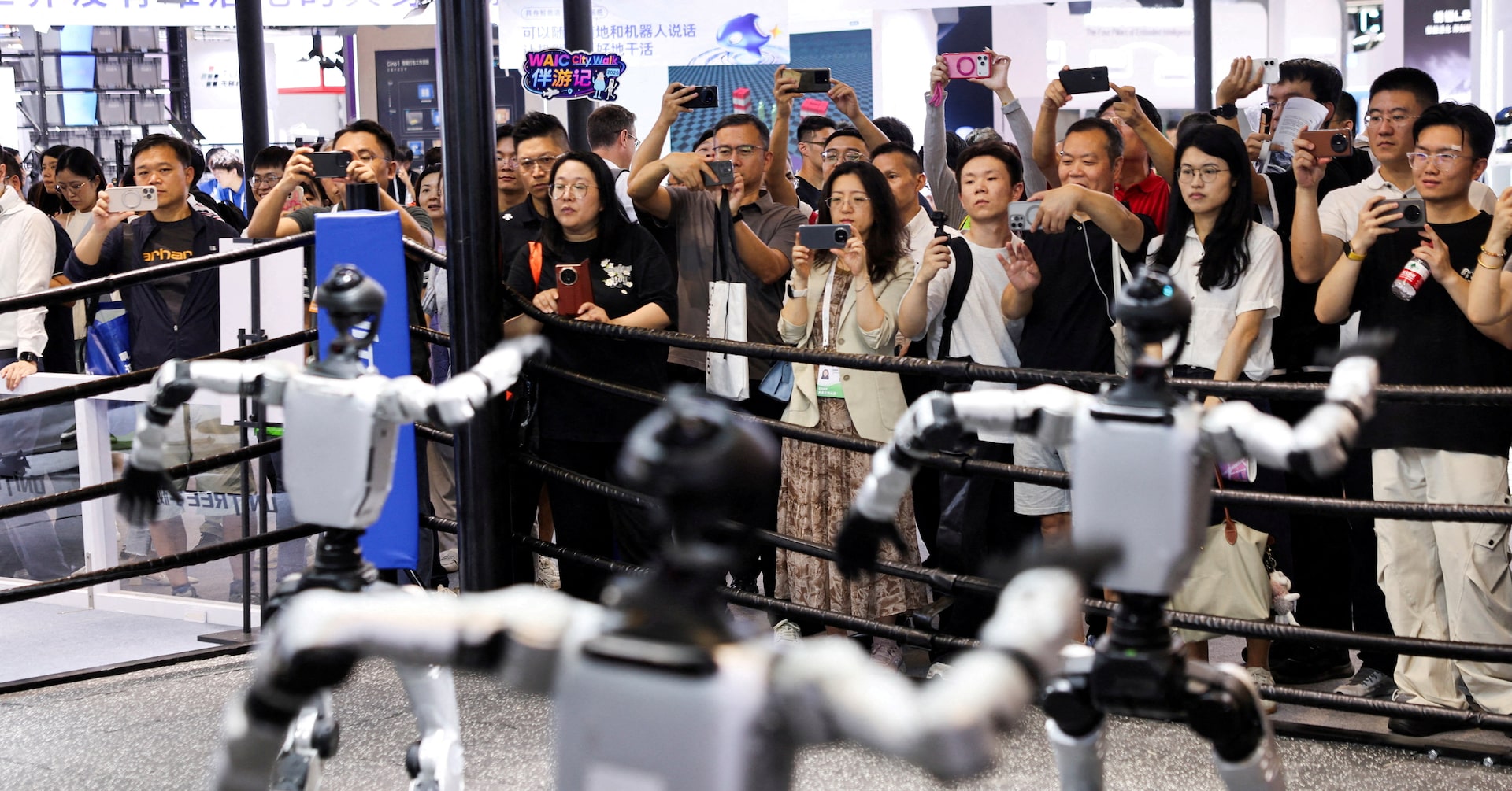
What is Unitree and why are China's humanoid robot makers racing to list?
Read source ↗
US House Democrats press Anthropic, OpenAI about rogue AI agents
Read source ↗Sources & qualifications (5)
Sources cited in the original report. Separate verification notes, where present, were added during the archive import.
- Learning more about Claude's mathematical capabilities \ Anthropic
- Learning more about Claude's mathematical capabilities \ Anthropic
- Expanding Daybreak as the Cyber Defense Window Narrows | OpenAI
- Nvidia, Wall Street firms partner on $500 billion AI financing venture, source says
- US House Democrats press Anthropic, OpenAI about rogue AI agents