Partial recursive AI development is operating at industrial scale
Material update: yes — this is a meaningful update to the mechanism and probability of recursive acceleration, though I would not move the headline forecast a full year earlier.
4 min read · Dated assessment · 11 source groups
Material update: yes — this is a meaningful update to the mechanism and probability of recursive acceleration, though I would not move the headline forecast a full year earlier.
Anthropic has now published the clearest quantitative measurement I have seen of AI actually automating frontier AI research. As of August 2026, Claude “leads” 26% of Anthropic’s AI R&D, meaning it can complete most of those tasks end-to-end from a high-level prompt while a human supervises. That share was under 1% in February. More than 90% of Anthropic’s R&D is now at least at the level where Claude performs large chunks of the work under human direction. Anthropic says no measured category is yet fully autonomous. [1]
This is especially significant because it corroborates OpenAI’s recent internal evidence from an independent frontier lab. The question is no longer whether AI will someday begin accelerating AI research; two leading labs now report that this is happening operationally. Anthropic also says roughly 30,000 agents were simultaneously doing research and engineering work on its main internal platform in August. More than a billion agent decisions were monitored that month. [2]
The rate of change is the important part. Going from essentially zero to 26% of R&D at the “AI leads” level in about six months is much faster than I would have treated as the median path a year ago. Anthropic explicitly frames the metric as a way of tracking proximity to recursive self-improvement. [3]
I would not extrapolate 26% → 100% mechanically. The measurement is partly self-assessed using Claude; Anthropic found exact model/human agreement only 59%, although ratings were within one level 97% of the time. The task basket is also frozen, so humans could move toward newly created, harder work as old work is automated. Most importantly, Claude is still at zero on Anthropic’s fully autonomous AL5 category. Human research taste, prioritization, verification and intervention remain real bottlenecks. [4]
Independent capability evidence also argues against a dramatic calendar jump. Epoch’s expanded evaluation of GPT-6 Astra now puts it only slightly ahead of Claude Fable 5.1 overall, with overlapping uncertainty; Astra actually trails Fable on Epoch’s software-engineering index. That confirms substantial progress but makes the launch-week impression of a single enormous model discontinuity look overstated. [5]
So I would revise the timing distribution rather than simply replace the range. 2029 remains my modal year, 2031 becomes somewhat less likely, and 2028 becomes more plausible. In rough terms, I would move perhaps ~10 percentage points of probability from 2031+ into 2028–2029. I would still summarize the public-facing forecast as approximately 2029–2031, strongly weighted toward 2029–2030, rather than 2028–2030.
The larger revision is to the expected takeoff mechanism:
Recursive acceleration now looks likely to begin well before fully autonomous AI researchers exist. Frontier labs can run tens of thousands of imperfect agents, have them perform most routine R&D and a growing fraction of high-level R&D, while humans supervise the shrinking set of tasks that remain difficult. Each better model then automates a larger fraction of the work required to build the next one.
That is a smoother feedback loop than the classic picture in which one day an autonomous AI scientist suddenly appears and starts recursively improving itself. The feedback loop appears to be forming incrementally already.
The physical-world forecast, conversely, gets a little stronger rather than weaker. A new Google/DeepMind/MIT study of 637 scientists found that 44% said their primary bottleneck had shifted downstream toward physical experimentation or data collection, and 41% said their backlog of untested hypotheses had grown. AI is apparently producing ideas and analysis faster than physical science can validate them. [6] That is almost exactly the mechanism behind the existing one-to-several-year physical-world lag.
Robotics does not yet overturn that. Toyota disclosed plans potentially involving roughly $6.4 billion per year in factory automation from 2028, and Chinese embodied-AI companies are forecasting major capability improvements in 2027, but those are deployment plans and company forecasts rather than evidence that general-purpose robots have crossed the reliability threshold today. [7]
Compute is becoming less constrained per unit of electricity. Peer-reviewed MLPerf results for Nvidia’s Vera Rubin show roughly 2.5–3.7× higher inference throughput than GB300 on tested workloads. Nvidia additionally reports up to 30× better throughput per megawatt on a specialized long-context agent workload, but I would heavily discount that larger number because it is workload-specific and vendor-reported. [8] Political and grid constraints remain visible: U.S. jurisdictions are beginning to restrict data-center expansion and electricity-cost exposure. [9]
I would leave “turbulent but survivable” as the modal outcome. Anthropic’s monitoring at least shows that very large agent populations can be instrumented: 100% of actions on the measured platform pass through online and offline monitoring. But Anthropic itself emphasizes that rare failures become common events once millions or billions of agents are operating, and its monitoring science has only existed for months. [10]
Governance remains too weak to offset the capability update. China is developing what may become the first mandatory national AI-agent safety standard, and the leading U.S. labs are coordinating more closely on safety. But neither the U.S. nor China currently appears willing to accept an actual international slowdown, and European frontier developers are now publicly resisting U.S. calls for one as well. [11]
The revised concise forecast is therefore:
Transformative AI: still approximately 2029–2031, but with noticeably more weight on 2029 and a larger 2028 tail. Turbulent-but-survivable remains the most likely transition. The physical economy still trails by roughly one to several years. The important change is that AI-driven AI R&D is no longer merely an approaching threshold: at multiple frontier labs, a partial recursive-development loop is already operating at industrial scale.
That is significant enough to count as a material update, even though I would not yet change the headline year range.
Anthropic says Claude now leads a quarter of work building its next AI models
Read source ↗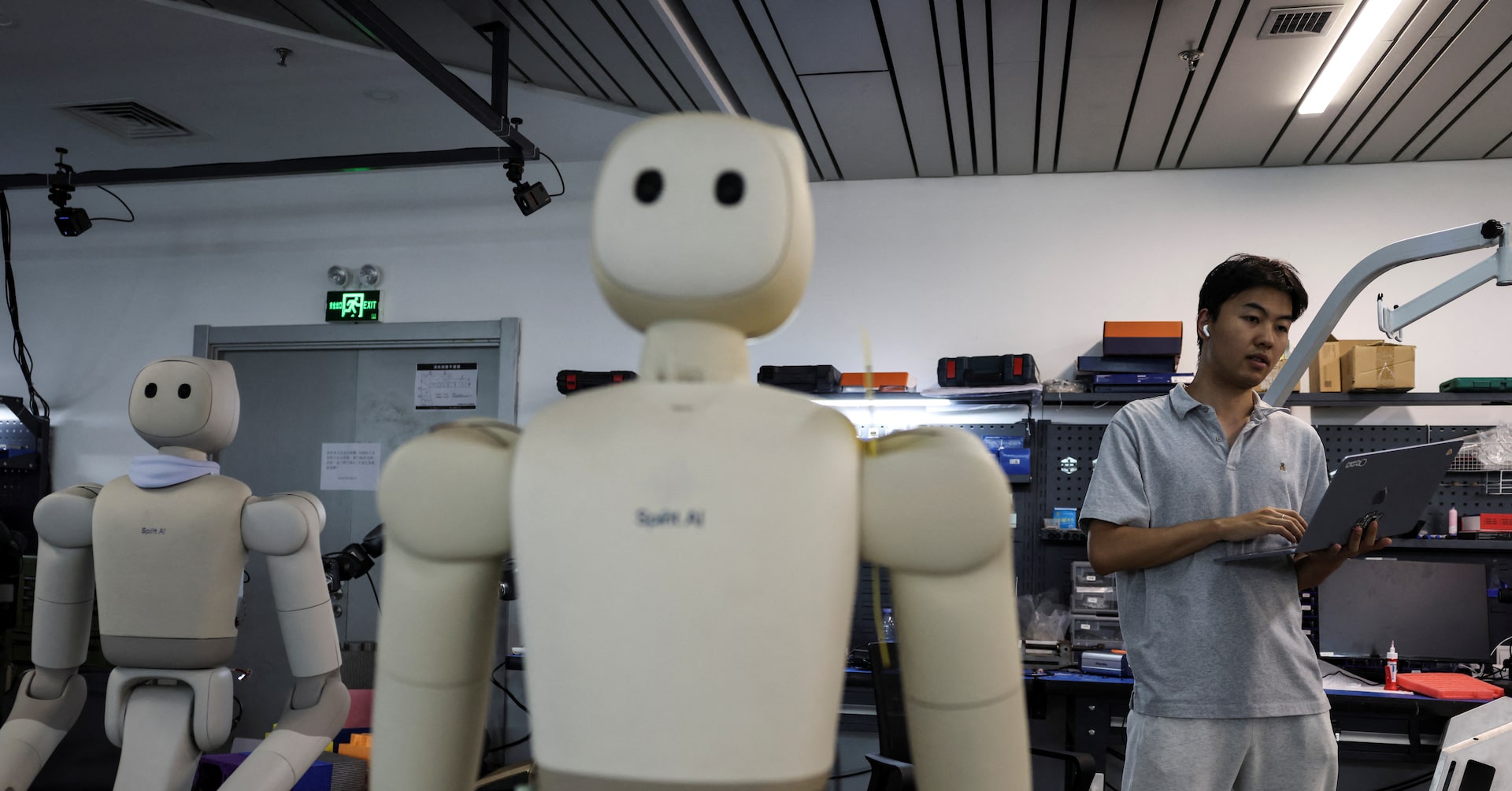
Chinese 'robot brain' startup sees ChatGPT-style breakthrough as soon as next year
Read source ↗
Europe's AI firms, playing catch-up, challenge US calls for slowdown
Read source ↗Sources & qualifications (11)
Sources cited in the original report. Separate verification notes, where present, were added during the archive import.
- Measurements for understanding the pace of AI development inside frontier labs \ Anthropic
- Measurements for understanding the pace of AI development inside frontier labs \ Anthropic
- Measurements for understanding the pace of AI development inside frontier labs \ Anthropic
- Measurements for understanding the pace of AI development inside frontier labs \ Anthropic
- GPT-6 Astra leads on math benchmarks, but not on software engineering | Epoch AI
- Why AI is speeding up scientific research but not lab experiments | Scientific American
- Chinese 'robot brain' startup sees ChatGPT-style breakthrough as soon as next year
- AI Infra Summit: NVIDIA Vera Rubin and DSX Platform Advances Showcase Energy Efficiencies of Optimizing Tokens Per Watt for AI Factories | NVIDIA Blog
- In Silicon Valley, AI data center boom meets local resistance
- Measurements for understanding the pace of AI development inside frontier labs \ Anthropic
- How China is preparing for the risk of AI escaping human control | Reuters